

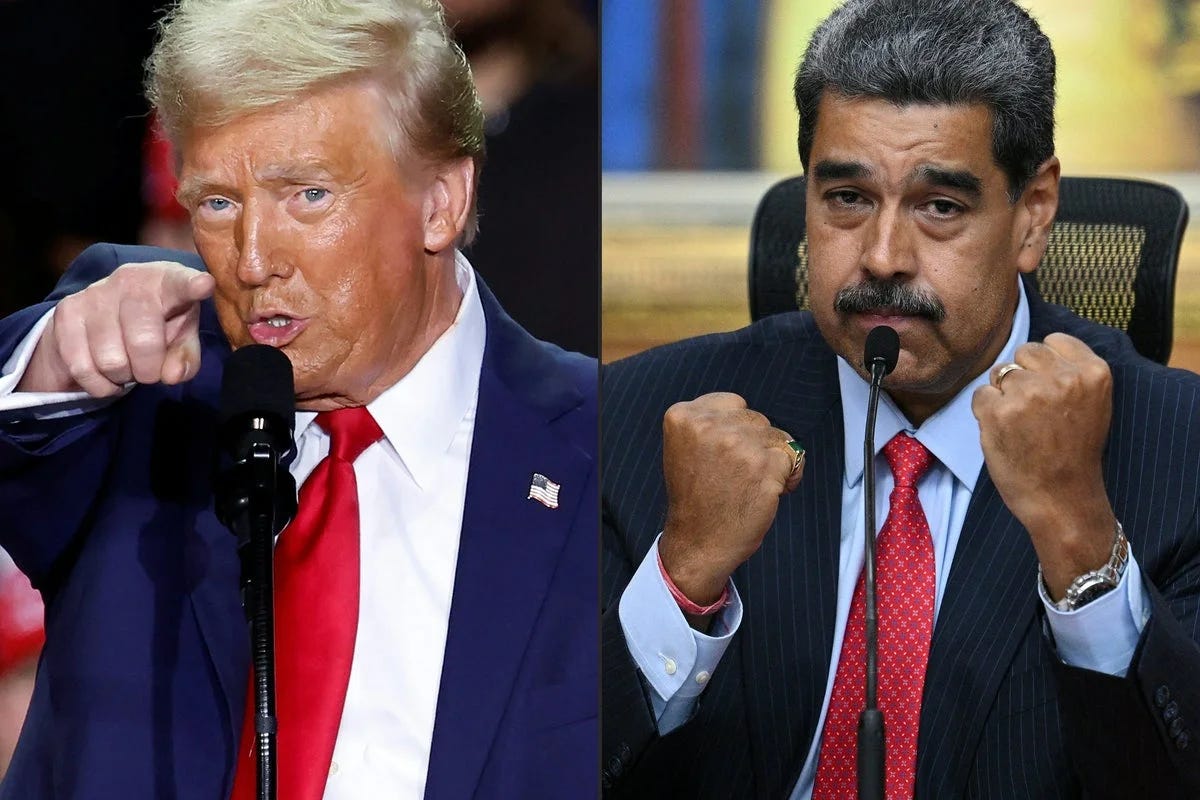
Continuing longstanding U.S. policy, Trump is ramping up the regime change war in Venezuela.
He has recently built up naval forces in the southern Caribbean, in a move that Venezuelan president Nicolás Maduro believes is an attempt to invade his country and overthrow his government.
Responding to the Trump ramp-up, Maduro said, “In the face of this maximum military pressure, we have declared maximum preparedness for the defence of Venezuela”.
Is the Trump administration planning on invading Venezuela for another regime change war? If so, it would only be an escalation of longstanding U.S. policy in Venezuela since the election of Hugo Chavez in 1999.
In this article, I will go over the history of regime change in Venezuela, which has led up to the current apparent escalation from the Trump administration.
CIA Interference.
When socialist Hugo Chavez was elected president of Venezuela in 1999, the CIA and American deep state were hell bent on overthrowing his government, upset that his socialist policies would restrict U.S. access to Venezuela’s resources, most notably its oil.
Since his election, the U.S government funneled money through the IRI( International Republican Institute), a subsidiary of the NED (National Endowment for Democracy) - a cutout of the CIA’s regime change arm- into the Venezuelan opposition.
As Mother Jones reported at the time, “IRI’s Latin America program was led by Georges Fauriol, who had previously worked at a conservative Washington think tank alongside Otto Reich, who had been Bush’s closest adviser on Latin America policy. Reich, who, according to Congress’s Government Accountability Office, conducted ‘prohibited covert propaganda’ on behalf of the Nicaraguan Contras in the 1980s, is a former ambassador to Venezuela who had frequently denounced Chavez.”
Mother Jones noted, “IRI staffed its program with Bush allies and campaign supporters; in turn, in 2001 the administration increased funding for IRI’s activities in Venezuela sixfold, from $50,000 to $300,000 — the largest grant any of NED’s democracy-promotion organizations received that year”.
The outlet also noted, “IRI staffers spent much of their time cultivating the opposition. IRI worked closely with Acción Democrática, a group that, IRI’s own documents acknowledge, ‘refused to recognize the legitimacy of the Chavez presidency.’ IRI also tutored opposition figures, including Caracas mayor Alfredo Peña, an outspoken Chavez critic, on how to create a political party” and that “IRI also used its own money to bring opposition figures to Washington, where they met with top U.S. officials”.
Eventually, this led to a coup against Chavez’s democratically elected government in 2002.
As Mother Jones wrote, “In April 2002, a group of military officers launched a coup against Chavez, and leaders of several parties trained by IRI joined the junta. When news of the coup emerged, democracy-promotion groups in Venezuela were holding a meeting to discuss ways of working together to avoid political violence; IRI representatives didn’t attend, saying that they were drafting a statement on Chavez’s overthrow. On April 12, the institute’s Venezuela office released a statement praising the ‘bravery’ of the junta and ‘commending the patriotism of the Venezuelan military.’”
Similar to the Maidan coup in Ukraine in 2014, the U.S.-backed coup was justified using a false flag massacre, done by the U.S.-funded opposition that was falsely blamed on Chavez’s forces.
As CounterPunch reported, “On April 11th,2002, the Venezuelan opposition activated snipers who fired on a largely pro-Chávez crowd that had gathered near Miraflores Palace to defend the president from the threat of an approaching and aggressive opposition march. Film footage from the ensuing gun battle was inserted into a pre-fabricated media strategy which sought to convince the Venezuelan population that government supporters were responsible for the deaths, and that they had acted directly on the orders of Chávez himself.”
Soon after, Chavez was reinstated into power when his supporters took to the streets and demanded a reversal of the U.S. coup.
But the U.S regime change attempts and political interference in Venezuela did not end there.
As Foreign Policy Magazine reported, “Venezuelan President Hugo Chavez frequently and famously accused the United States of covertly trying to overthrow him, but only after his death did evidence emerge to support his seemingly paranoid claims”.
The Magazine wrote, “A WikiLeaks cable released in 2013 outlined the U.S. strategy for undermining Chavez’s government by ‘penetrating Chavez’s political base,’ ‘dividing Chavismo,’ and ‘isolating Chavez internationally.’ The strategy was to be carried out by USAID’s Office of Transition Initiatives, … and involved funding opposition organizations in Venezuela.”
After Chavez’s death in 2013, the regime change policy continued against his successor, Nicolás Maduro, the current leader of Venezuela.
In 2015, U.S. interference successfully swung the Venezuelan national assembly to the U.S.-backed opposition for the first time since Chávez’s victory.
As Jacobin Magazine reported, “Beginning in October 2013, the National Endowment for Democracy (NED) — a government agency created by the Reagan administration — provided nearly $300,000 for the National Democratic Institute (NDI) for a program titled ‘Venezuela: Improved Training and Communications Skills for Political Activists’.”
The magazine noted that the program bragged that the NED, “mobilized a voter database that identified and targeted swing voters through social media” and that “indeed, in December 2015, the opposition won a majority in the Venezuelan National Assembly for the first time since Chávez came to power in 1999”.
Jacobin noted that, “the NDI claims credit for the opposition’s success, writing that this strategy ‘ultimately played an important role in their resounding victory in the 2015 election’ and that a ‘determining factor in the success of the coalition in the parliamentary elections of 2015 was a two-year effort prior to the elections to raise awareness, train and align national and regional structures of communication of all the parties that conform the MUD’” (Mesa de la Unidad Democrática, the U.S. funded opposition party).
Since 2015, the U.S. has also funded a series of violent riots in Venezuela.
The U.S. National Endowment for Democracy spent 3.7 million on “Program for the Promotion of Democratic Ideas and Values” in South America between 2016 and 2017, much of which went to supporting the violent Guarimbas riots in Venezuela in 2017.
While the riots were portrayed as peaceful in the U.S. media, journalist Abby Martin reported on them on the ground and found this was far from the case.
Martin noted that out of 84 deaths, the majority (at least 61 deaths) were caused by the U.S.-backed violent rioters.
Martin reported that “factories, public transportation, socialist party offices, hospitals, and clinics” were all attacked by the U.S.-backed riots, along with “the childhood home of Chavez, the government's housing agency, a maternity clinic, a cultural centre which gave free music lessons to youth and food distribution centres”.
Eventually, in 2019, Donald Trump recognized Juan Guaidó, an unelected American puppet with no political power, as the official president of Venezuela.
Between 2018 and 2020, the United States funneled $1 billion to Juan Guaidó’s fake “interim government”.
Guaidó and his supporters used this U.S. funding and recognition to repeatedly attempt to violently overthrow the actual Venezuelan government led by Nicolás Maduro, including with a failed military coup in 2019.
In 2020, Juan Guaidó even stormed Venezuela’s National Assembly after declaring himself president, despite not being elected.
U.S. Senator Cris Murphy later admitted that “we tried to sort of construct a kind of coup” in Venezuela and that “we thought that getting Guaidó to declare himself president would be enough to topple the regime”.
The U.S. government even attempted to funnel arms to the Venezuelan opposition disguised as humanitarian aid packages through USAID.
John Bolton-then Trump’s national security advisor- later admitted that this coup attempt was done to take Venezuela’s oil, saying, “If we could have American oil companies really invest in and produce the oil capabilities in Venezuela it would be good for the people of Venezuela and it would be good for the people of the United States, we both have a lot at stake here making this come out the right way.”
Trump, on the campaign trail in 2024, also admitted this, saying, “When I left, Venezuela was ready to collapse, we would have taken it over, we would have gotten all that oil, it would have been right next door”.
A Barbaric Sanctions Regime.
The endless coups and political interference have not been the only aspect of the United States’ regime change strategy in Venezuela.
Along with the coup attempts, the United States has increasingly placed barbaric sanctions on Venezuela that deprive the population of basic needs, in hopes that it will lead them to overthrow the government.
The harshest U.S. sanctions on Venezuela from 2017-2019 killed at least 40,000 people, according to a study from economists Jeffrey Sachs and Mark Weisbrot.
Overall, the sanctions caused over 100,000 deaths in the country, according to research from Alfred de Zayas, an expert formerly from the UN Human Rights Council.
Francisco Rodríguez, a Venezuelan opposition economist, put out a detailed study which found that every time Venezuela’s oil production - the country’s main export and source of revenue- began to recover, U.S. sanctions caused it to crash again.
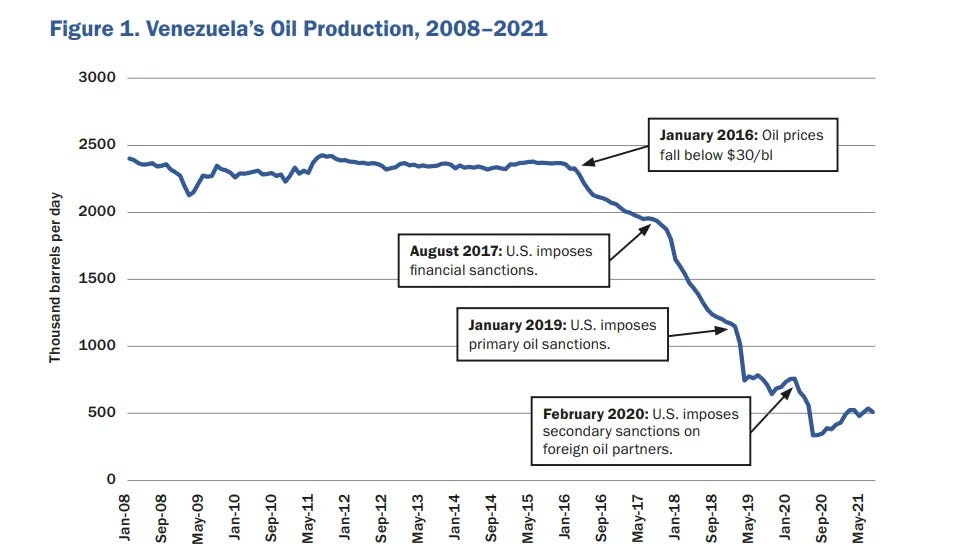
He noted that experts predicted that Venezuelan oil production was expected to recover by 2017 had it not been for the U.S. sanctions, writing “oil industry analysts were predicting a stabilization of Venezuelan oil output, and economic analysts were predicting modest economic growth fueled by the recovery of oil prices as late as mid-2017. The severe decline in oil production was completely unforeseen, even by the forecast models that took full account of the well-known decline in investment at the time”.
He noted that “economic sanctions and other actions of economic statecraft aimed at the Venezuelan government have strongly impacted the country’s economic and humanitarian conditions” and that “it is hard to deny that they have had a sizable negative impact on living conditions in the country”.
Another detailed report from the UN’s sanctions expert, Alena Douhan, wrote that because of economic sanctions on Venezuela:
-Electricity lines are able to work at less than 20 per cent of their capacity
-An estimated 90% of households are connected to the national water distribution system. Numerous households, however, report frequent cuts because of electricity outages affecting water pumps and the maintenance of infrastructure, and because of the shortage of qualified maintenance staff.
-Impediments to food imports, constituting more than 50 per cent of food consumption, have resulted in the steadily growth of malnourishment in the past 6 years with more than 2.5 million people being severely food insecure.
-Venezuela has been almost entirely dependent upon medicine imported from abroad, while the majority of public medical services were provided by the state free of charge before 2016. Impediments to health care include a lack or severe insufficiency of medicines and vaccines; price growth; electricity shortages to supply equipment; water shortages and sanitation problems that affect hygiene; decaying infrastructure because of a lack of maintenance, the absence of spare parts, the unavailability of new equipment due to the lack of resources or refusals to sell or deliver; degraded working conditions and a lack of protective equipment against infectious diseases; a loss of staff in all medical areas because of low salaries; and the termination of construction of hospitals and primary health care centers.
-School and university education has faced a serious decrease in governmental support since 2016, including the termination or reduction of the supply of school uniforms, shoes, backpacks and office supplies; and a reduction of the number of daily meals at school (from 2 to 1), the diminution of their quantity and food diversity or their total cancellation.
She noted that, “the absence of resources and reluctance of foreign partners, banks and delivery companies to deal with Venezuelan partners results in the impossibility to buy necessary medical and technological equipment, reagents and spare parts for the repair and maintenance of electricity, gas, water, public transport, telephone and communication systems, schools, hospitals, houses and other public institutions, thus undermining the enjoyment of many human rights, including the right to a decent life.”
She concluded that due to the U.S. sanctions, “low-income people, women, children, and people with special needs or chronic or severe diseases are affected most with regard to the whole scope of human rights, including civil, political, economic, social and cultural rights and the right to development”.
In a recent article for the LA Times, economist Mark Weisbrot wrote :
In Venezuela, the first year of sanctions under the first Trump administration took tens of thousands of lives. Then things got even worse, as the U.S. cut off the country from the international financial system and oil exports, froze billions of dollars of assets and imposed “secondary sanctions” on countries that tried to do business with Venezuela.
Venezuela experienced the worst depression, without a war, in world history. This was from 2012 to 2020, with the economy contracting by 71% — more than three times the severity of the Great Depression in the U.S. in the 1930s. Most of this was found to be the result of the sanctions.
After years of coup attempts, political interference, and crushing sanctions have failed to achieve the United States’ regime change goal in Venezuela, it seems Trump is now planning on a military invasion to fulfill the longstanding regime change goal.
As he bragged on the campaign trail, “When I left, Venezuela was ready to collapse, we would have taken it over, we would have gotten all that oil”.
Note to readers: The Dissident is a reader-supported outlet. If you liked this article, consider becoming a paid subscriber.
Trump was put over the top in the general election by independent voters who liked his 'no more wars' rap. Instead, we've gotten his making America complicit and paying for the biggest RT genocide in our lifetime, subsidizing Israeli lifestyles and free healthcare, paying for most of the Ukraine war, bombing Iran (for Israel), and now this. The guy is a liar.
The Venezuelan government nationalized it's oil business since the 70s. So, for 50 years we were unmoved by them taking care of their little country. Tyrants or communists? We live in America, and we had a whole mess of Tyrants a- holes ruling us, and we have never seen Brazil or Russia invading us to liberate us from such tyrants.