
John Mearsheimer Debunks The EU's Ukraine War Propaganda To It's Face.
Professor John Mearsheimer Meticulously Debunked The EU's Propaganda At The European Parliament.

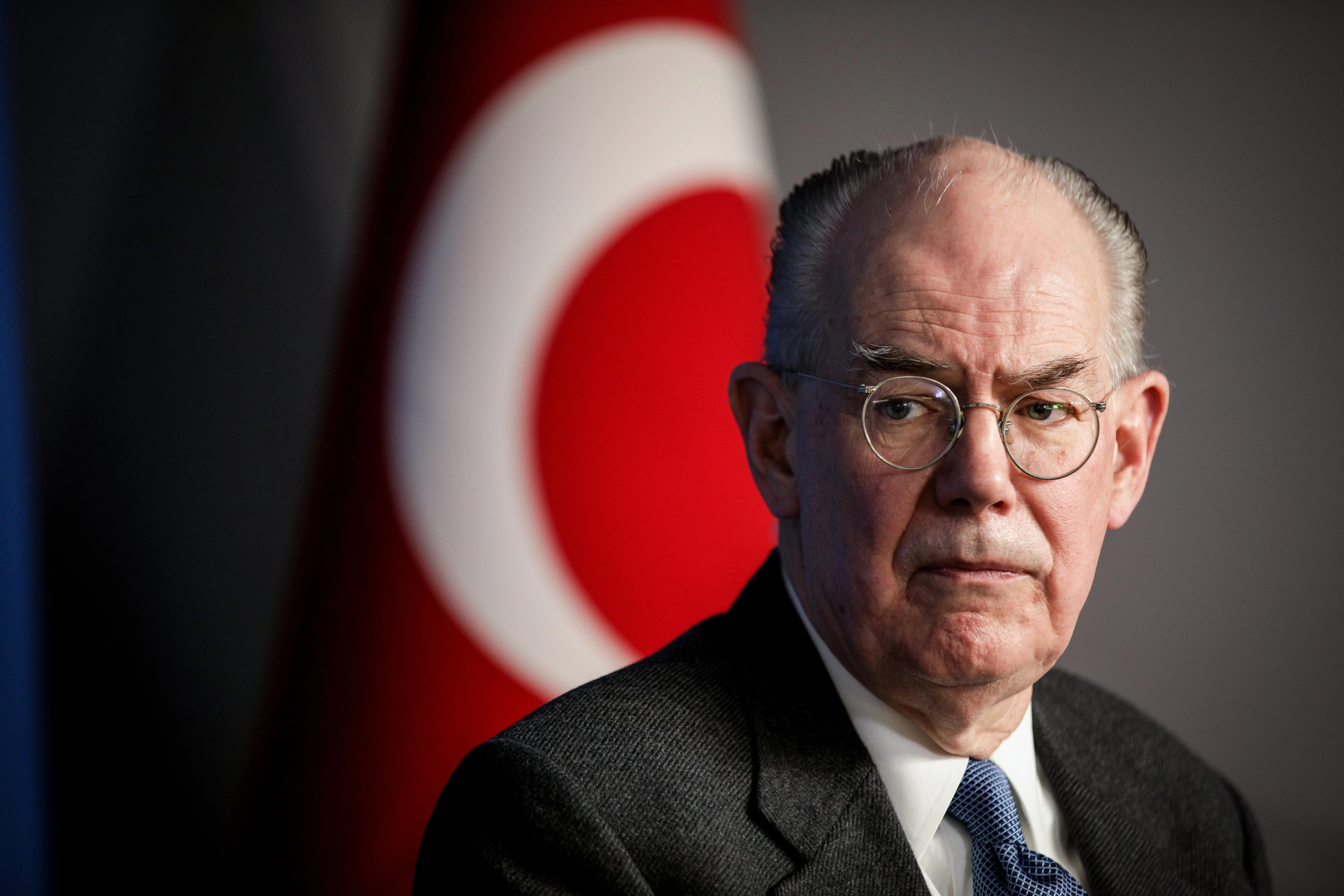
Written By: Justin K.P.
Professor of Political Science at the University of Chicago, John Mearsheimer, recently gave a speech to the EU’s European Parliament, where he debunked the EU’s delusions about the Ukraine war to its face.
More specifically, Mearsheimer meticulously debunked what he called the “conventional wisdom in the West,” namely that Putin’s goal “is to conquer all of Ukraine and make it part of a greater Russia. Once that goal is achieved, Russia will move to create an empire in Eastern Europe, much like the Soviet Union did after World War II. In this story, Putin is a mortal threat to the West and must be dealt with forcefully. In short, Putin is an imperialist with a master plan that fits neatly into a rich Russian tradition.”
As Mearsheimer documented, this narrative is patently false.
As he noted, “there’s no evidence from before 24th February 2022 that Putin wanted to conquer all of Ukraine and incorporate it into Russia.”
Putin, he noted, repeatedly accepted the geopolitical reality that the Soviet Union had dissolved, for example writing, “you want to establish a state of your own, you are welcome” in a 2021 article written to the Ukrainian people, and writing “what Ukraine will be, it is up to its citizens to decide”.
He also noted that on February 21st of 2022, Putin wrote, “ the new Russia accepts the new geopolitical reality that took shape after the dissolution of the USSR,” a point he “reiterated 3 days later on 24 February 22”.
John Mearsheimer similarly noted “I estimate that Russia invaded Ukraine with at most 190,000 troops. General Syrsky, who, as you all know, is now the present commander of the Ukrainian forces, estimates that the Russians invaded Ukraine with 100,000 troops, adding, “There is no way that a force numbering either 100,000 or 190,000 could conquer, occupy, and absorb all of Ukraine into a greater Russia.”
The real reason behind Russia’s invasion of Ukraine in February of 2022, Mearsheimer noted, was because, Ukraine “was armed and trained by NATO, and it was becoming a de facto member of NATO”.
Russia’s goal “was to quickly achieve limited territorial gains and force Ukraine to the bargaining table. Which is what happened.”
This- unlike the claim that Putin wanted to rebuild the Soviet Union- is backed by actual evidence.
“Immediately after the war began, Russia, not Ukraine, Russia reached out to Ukraine to start negotiations to end the war and work out a modus vivendi between the two countries. This move is directly at odds with the claim that Putin wanted to conquer Ukraine and make it part of the greater Russia,” John Mearsheimer noted.
“Negotiations between Kyiv and Moscow began in Belarus just four days, four days after the Russian invasion. And that Belarus track was eventually replaced by an Israeli as well as an Istanbul track. The available evidence indicates that the Russians were negotiating seriously and were not interested in absorbing Ukrainian territory save for Crimea, which they had annexed in 2014, and possibly the Donbas region,” Mearsheimer added.
Ukrainian negotiator Oleksandr Chalyi said during the Istanbul talks that ‘we were very close’ to ending ‘our war with some peaceful settlement ’” and that “‘Putin tried to do everything possible to conclude [an] agreement with Ukraine’ and ‘really wanted to reach some peaceful settlement.’ And in Istanbul, the two sides ‘managed to find a very real compromise.’”
“The negotiations ended when the Ukrainians, with prodding from Britain and the United States walked away from the negotiations which were making good progress at the time”, John Mearsheimer noted, a fact that is backed up by an endless list of diplomats who took part in the negotiations , most recently by Iuliia Mendel, the former press secretary for Ukrainian president Volodymyr Zelenskyy.
John Mearsheimer noted that:
… in the months before the war started, Putin tried to find a diplomatic solution to the brewing crisis. On 17 October 2021, remember the war begins February 2022. This is 17 December 2021. Putin sends letters to both President Biden and to NATO Chief Jens Stoltenberg proposing a solution to the crisis based on a written guarantee that does three things. Says, number one, Ukraine would not join NATO. Number two, no offensive weapons would be stationed near Russia’s borders. And number three, NATO troops and equipment moved into Eastern Europe since 1997 would be moved back to Western Europe. Whatever one thinks of the feasibility of reaching a bargain based on Putin’s opening demands, it shows he was trying to avoid war. The United States, on the other hand, refused to negotiate with Putin. It appears it was not interested in avoiding war.
Amanda Sloat, the Biden administrations senior director for Europe at the National Security Council admitted that, “We had some conversation even before the war started, about what if Ukraine comes out and just says to Russia, ‘fine, you know, we won’t go into NATO if that stops the war, if that stops the invasion,’ which at that point it may well have done” adding “one option would have just been for Ukraine to say in January of 2022, ‘fine, you know, we won’t go into NATO, we will stay neutral.’ Ukraine could have made a deal around March/April of 2022 around the Istanbul talks, There is certainly a question, almost three years on now, would that have been better to do before the war started, would that have been better to do in Istanbul talks, it certainly would have prevented the destruction and the loss of life”.
Finally, John Mearsheimer noted, “Putting Ukraine aside, there is not a scintilla of evidence that Putin was contemplating conquering any other countries in Eastern Europe. And this is hardly surprising given that the Russian army is not even large enough to overrun all of Ukraine, much less to conquer the Baltic states, Poland, and Romania. Plus those countries outside of Ukraine are all NATO members, which would almost certainly mean war with the United States and its allies.”
Mearsheimer concluded this portion saying, “While it is widely believed in Europe, and again, I’m sure here in the European Parliament, that Putin is an imperialist who has long been determined to conquer all of Ukraine and then conquer additional countries west of Ukraine, virtually all the available evidence is at odds with this perspective. In fact, the United States and its and its European allies provoked the war.”
Mearsheimer explains correctly that “the underlying cause of the conflict was the NATO decision to bring Ukraine into the alliance” which “virtually all Russian leaders saw as an existential threat that must be eliminated”, along with “bringing Kiev into the European Union and promoting a color revolution in Ukraine”, in reference to the 2014 CIA coup against Ukraine’s elected president Viktor Yanukovych.
The three real reasons for the war in Ukraine, John Mearsheimer noted, were “One is NATO expansion into Ukraine, two is EU expansion into Ukraine, and three is regime change”.
“Russian leaders fear all three prongs of this policy, but they fear NATO expansion the most” he noted.
He cited a 2008 memo by William Burns, who was then U.S. ambassador to Russia and later Biden’s CIA director, after NATO officially invited Ukraine and Georgia to join NATO where he wrote that “Ukrainian entry into NATO is the brightest of all red lines for the Russian elite, not just Putin. In more than two and a half years of conversations with key Russian players from knuckle draggers in the dark recesses of the Kremlin to Putin’s sharpest liberal critics, I have yet to find anyone who views Ukraine and NATO as anything other than a direct challenge to Russia’s interests.”
John Mearsheimer noted that Burn wrote NATO expansion into Ukraine “would be seen as throwing down the strategic gauntlet. Today’s Russia will respond. Russian-Ukrainian relations will go into a deep freeze. It will create fertile soil for Russian meddling in Crimea and Eastern Ukraine”.
In another 2008 memo from William Burns released on WikiLeaks, he even predicted that NATO expansion into Ukraine would provoke a Russian invasion of Ukraine, wiring, :
Ukraine and Georgia’s NATO aspirations not only touch a raw nerve in Russia, they engender serious concerns about the consequences for stability in the region. Not only does Russia perceive encirclement, and efforts to undermine Russia’s influence in the region, but it also fears unpredictable and uncontrolled consequences which would seriously affect Russian security interests. Experts tell us that Russia is particularly worried that the strong divisions in Ukraine over NATO membership, with much of the ethnic-Russian community against membership, could lead to a major split, involving violence or at worst, civil war. In that eventuality, Russia would have to decide whether to intervene; a decision Russia does not want to have to face.
John Mearsheimer also noted that several NATO country leaders had similar concerns at the Bucharest NATO summit in 2008, where the decision was announced.
He noted:
Both Angela Merkel, who was then the German Chancellor, and French President Nicolas Sarkozy adamantly opposed moving forward to bring Ukraine into NATO. And this is what Merkel said about her thinking at the time. This is really, truly remarkable. Merkel said, “I was very sure that Putin is not going to just let that happen. From his perspective, that would be a declaration of war.”
That’s Angela Merkel speaking. She is saying that the decision that was made in the April 2008 meeting in Bucharest that saying Ukraine would be allowed to come in to NATO would be seen by the Russians as a declaration of war.
Secretary General of NATO from 2014 to 2024, Jens Stoltenberg, acknowledged in his memoir that at the 2008 summit, several NATO member state leaders thought “granting Ukraine (NATO) membership would provoke Moscow, leading to an increased risk of crisis and conflict in Europe”.
John Mearsheimer concluded:
The war could have been avoided if the West had not decided to bring Ukraine into NATO, or even if it had backed off from commitment once the Russians made that up their opposition clear. Had that happened, Ukraine would almost certainly be intact today within its pre-2014 borders, and Europe would be more stable and more prosperous. You just want to think about what I’m saying here. Had we not made the decision to bring Ukraine into NATO in April of 2008, or if once having made that decision, we saw how clear-cut Russian opposition was, had we backed off, Ukraine would be intact today inside its pre-2014 borders. Crimea would still be part of Ukraine. And furthermore, Europe would be a more prosperous and more stable place than it is. But that ship has sailed, and Europe must now deal with the disastrous results of a series of avoidable blunders.
Note to readers: The Dissident is a reader-supported outlet. If you liked this article, consider becoming a paid subscriber.
The purpose of war in the US is that it is the most efficient way to transfer public money into private hands. There must continuously be war to feed that ravenous implacable maw. When one war winds down, the next one starts up. Until we dismantle those interests, we will continue to be always at war.
Professor Mearsheimer has been articulate and consistent in his analysis of the Ukraine conflict for over a decade.
And for over a decade he’s nailed it.
Great piece on this subject.