
Despite Killing Ali Khamenei, The U.S./Israeli Regime Change Plan Is Backfiring.
The Regime Change War Is Not Going To Plan.

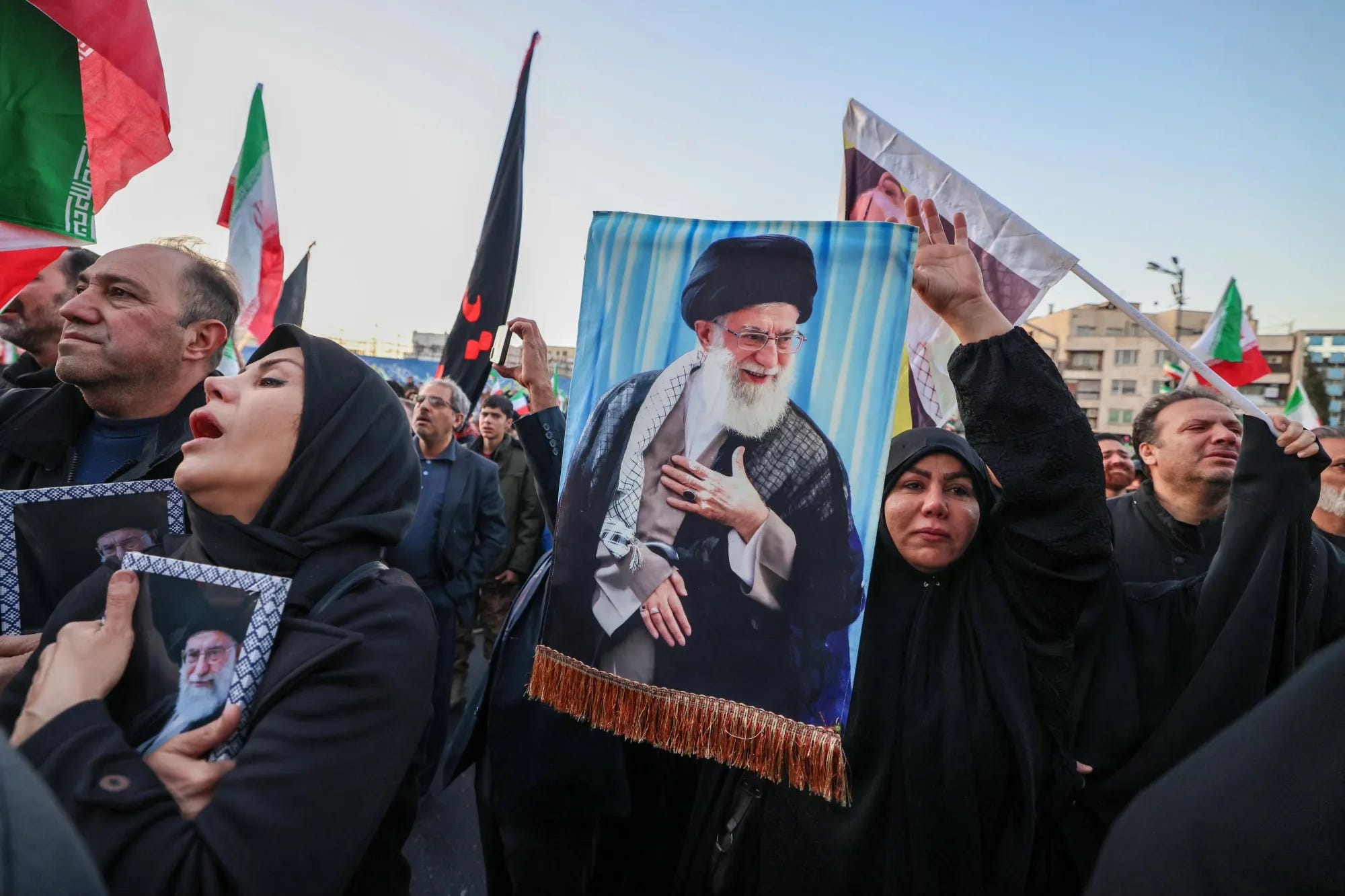
The U.S. and Israel have killed Iran’s Supreme Leader, Ali Khamenei, but their planned hope of regime change- that the death of Khamenei would lead to the collapse of the Iranian state and for Iranians in opposition to “rise up” against the government- is backfiring.
Iran Made Plans To Deal With Assassinations.
Unlike in Syria or Libya, where the overthrow of the head of state led to a collapse of the regime, Iran made plans to deal with potential assassinations of its top leaders to prevent full regime change.
The New York Times reported that before Khamenei’s death- in preparations for regime change assignations- he appointed, a “handful of other close political and military associates to ensure that the Islamic Republic survives not only American and Israeli bombs, but also any assassination attempts on its top leadership, including on Ayatollah Khamenei himself”.
According to the report, “he has named four layers of succession for each of the military command and government roles that he personally appoints”, and “has also told everyone in leadership roles to name up to four replacements and has delegated responsibilities to a tight circle of confidants to make decisions in case communications with him are disrupted or he is killed.”
As journalist Rania Khalek noted , “The Iranians were prepared for this, which is why they still managed to carry out their retaliation yesterday after the Supreme Leader and other senior officials were assassinated.”
As the Centre for Islamic and West Asian Studies’s Ali Hashem noted in Foreign Policy magazine , “Iran Is Built to Withstand the Ayatollah’s Assassination”.
Hashem noted that while the U.S. and Israel were hoping for full regime collapse in Iran, Iran is built to withstand regime change attempts, writing:
The latest Israeli and U.S. war on Iran began with airstrikes on the home and offices of Supreme Leader Ali Khamenei. The premise seemed to be that Khamenei’s sudden elimination would pose a dire threat to the current ruling system. The goal would be to achieve what happened in Libya after Muammar al-Qaddafi or in Syria after Bashar al-Assad, where regimes collapsed as soon as their leaders were no longer in power. In those systems, the state’s future was tied to a single person.
But Iran’s history and approach to survival are different. Few contemporary governments concentrate as much visible authority in a single office as Iran does in that of the supreme leader. Religious legitimacy, command of the armed forces, and ultimate political arbitration converge there.
Yet visibility should not be confused with fragility. The office rests atop a dense network of institutions designed not simply to serve the leader but to constrain him, monitor him, and, if necessary, outlast him. The Islamic Republic is not just a personal regime with religious language. It is a revolutionary system that has invested heavily in planning for leadership changes. When under pressure, its structure is designed to pull together rather than fall apart.
He noted, “one should expect a change in leadership in Tehran to be treated less as an ending and more as a chance for the country’s institutions to show they can survive.”
Iranian People “Rise Up”- Against The U.S. and Israel.
U.S. and Israeli officials made clear their hope was that after killing Ali Khamenei, the Iranian people would “rise up” and effect regime change.
Trump, announcing the war, said :
to the great, proud people of Iran, I say tonight that the hour of your freedom is at hand. Stay sheltered. Don’t leave your home. It’s very dangerous outside. Bombs will be dropping everywhere. When we are finished, take over your government. It will be yours to take. This will be, probably, your only chance for generations.
For many years, you have asked for America’s help, but you never got it. No president was willing to do what I am willing to do tonight. Now you have a president who is giving you what you want, so let’s see how you respond. America is backing you with overwhelming strength and devastating force. Now is the time to seize control of your destiny and to unleash the prosperous and glorious future that is close within your reach. This is the moment for action. Do not let it pass.
Similarly, one Israeli official told Axios that the regime change plan in Iran was dependent on “the extent to which the Iranian people rise up”.
While there have certainly been different reactions across Iran over the killing of Ali Khamenei (it would be absurd to think a nation of 93 million people were unified in public opinion), many Iranians have “risen up” to mourn Ali Khamenei and demand a response from Iran on the U.S. and Israel.
Middle East Eye reported :
Thousands of mourners have gathered across Iran to mourn and protest following the death of Supreme Leader Ali Khamenei.
Mourners gather in Enghelab Square in Tehran, many dressed in black, waving Iranian flags and holding photos of Khamenei.
According to AFP, they chanted slogans including “Death to America” and called for retaliation against Israel and the US.
Middle East Eye reported that the mournings and demonstrations against the U.S. and Israel spread further than Iran, writing:
Scenes of mourning and protest over Khamenei’s killing were also reported outside Iran, including in the Iraqi capital Baghdad, in Kashmir and in Karachi, Pakistan.
At least six people were killed in Karachi amid violent confrontations between demonstrators and security forces.
As journalist Ali Abunimah noted :
Right away, President Donald Trump and Israeli Prime Minister Benjamin Netanyahu, the perpetrators of this crime, got what they asked for: Iranians poured into the streets.
They were not there to protest their government and overthrow it – as the warmongers had demanded – but to mourn their martyred leader and demand revenge.
Killing Khamenei Makes An Iranian Nuke More Likely.
The most ironic element of the U.S.’s failed regime change attempt in Iran- which was done in the name of stopping Iran’s non-existent quest for a Nuclear Weapon- is that it was Ali Khamenei and his predecessor Ruhollah Khomeini who were primarily preventing Iran from developing Nuclear Weapons.
Journalist Gareth Porter reported that during the Iran/Iraq War, “Mohsen Rafighdoost, who served as minister of the Islamic Revolutionary Guard Corps (IRGC) throughout the eight-year war, revealed that he had proposed to Khomeini that Iran begin working on both nuclear and chemical weapons — but was told in two separate meetings that weapons of mass destruction are forbidden by Islam.”
Porter reported that when Iraq was using chemical weapons on Iran, “Khomeini ruled out development of chemical and biological weapons as inconsistent with Islam. ‘Imam told me that, instead of producing chemical or biological weapons, we should produce defensive protection for our troops, like gas masks and atropine,’ Rafighdoost said.”
Gareth Porter noted:
Rafighdoost also told Khomeini that the group had “a plan to produce nuclear weapons.” That could only have been a distant goal in 1984, given the rudimentary state of Iran’s nuclear program. At that point, Iranian nuclear specialists had no knowledge of how to enrich uranium and had no technology with which to do it. But in any case, Khomeini closed the door to such a program. “We don’t want to produce nuclear weapons,” Rafighdoost recalls the supreme leader telling him.
Khomeini instructed him instead to “send these scientists to the Atomic Energy Organization,” referring to Iran’s civilian nuclear-power agency. That edict from Khomeini ended the idea of seeking nuclear weapons, according to Rafighdoost.
He added, “Former Iranian nuclear negotiator Seyed Hossein Mousavian, now a research scholar at Princeton University, confirmed for this article that Khomeini’s fatwa against chemical and nuclear weapons, which accounted for the prime minister’s extraordinary statement, was indeed conveyed in the meeting with Rafighdoost.”
Porter noted, “Khomeini’s Islamic ruling against all weapons of mass destruction, including nuclear weapons, was continued by Ali Khamenei, who had served as president under Khomeini and succeeded him as supreme leader in 1989” adding that, “Khamenei had actually issued the anti-nuclear fatwa without any fanfare in the mid-1990s in response to a request from an official for his religious opinion on nuclear weapons.”
As late as March of late year, U.S. intelligence assessed that Ali Khamenei stayed true to Ruhollah Khomeini’s fatwa against chemical and nuclear weapons, despite pressure on him to reverse course, noting, “We continue to assess Iran is not building a nuclear weapon and that Khamenei has not reauthorized the nuclear weapons program he suspended in 2003, though pressure has probably built on him to do so.”
As journalist Jonathan Cook put it :
Congratulations to the US for killing Ayatollah Khamenei, Iran’s supreme leader and a steadfast opponent of Iran developing nuclear weapons.
Doubtless, Iran’s new leader will learn from Khamenei’s mistake and expedite an Iranian nuclear bomb as quickly as possible.
Note to readers: The Dissident is a reader-supported outlet. If you liked this article, consider becoming a paid subscriber
Why does the U.S. take on more debt every year to fund Israeli aggression. We pay the principal and the interest.
notanotherdollar.com
Dare I say the child raping PSA🇺🇸Pedophilia States of America needs a “Regime Change”, like January 21, 2025. Nations that fall to illegal coup usually end up with Renee Good, Alex Pretti, Keith Porter, 🕊️ and little children with bunny 🐰 ear hats being tortured. SOS FREE WORLD! Come get this orange pedophile SOB, ASAP!!!!! We don’t care how you do it. The American People Thank You!